

2026 Global Energy Report: Why Buyers Are Moving from Green Pledges to Industrial Execution
The era of 'green promises' is over—2026 is officially the year of industrial execution. As AI drives global power demand to record highs, securing a resilient and storage-backed supply chain is no longer optional. Read our latest briefing on how to navigate the 2026 'Power Crunch' and stay ahead of the competition.
GLOBAL TRADECARBON CREDITSRENEWABLE ENERGYAI TECHNOLOGYAI TECHNOLOGYESGSUSTAINABLE BUSINESSCLIMATE ACTION
DW Global Sourcing Press
2/3/20263 min read
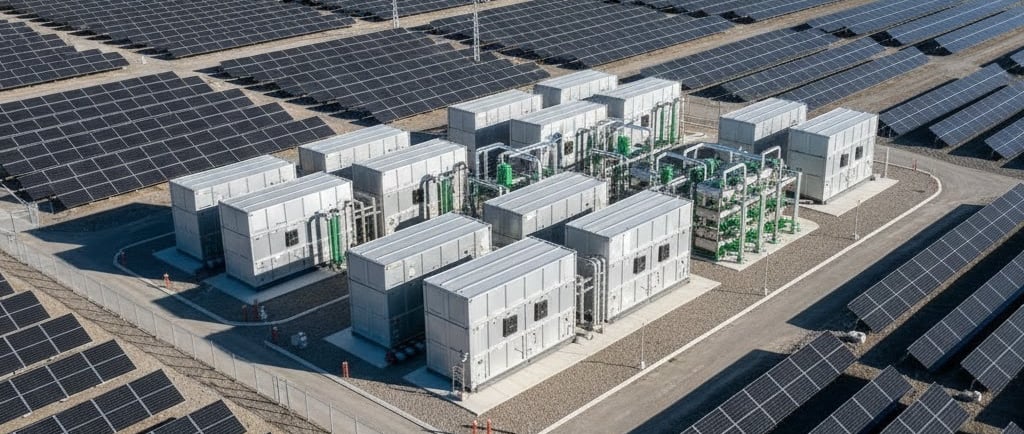
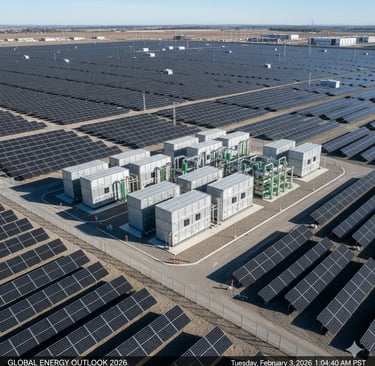
As of February 2026, the global energy transition has entered a decisive execution phase. The conversation is no longer driven by long-term climate pledges, but by near-term industrial realities: grid congestion, geopolitical fragmentation, and the unprecedented power demand created by AI and electrification.
Across recent projects, we’re seeing developers delay procurement not because of pricing—but because grid access, storage readiness, and delivery risk have become the real bottlenecks.
For professional energy and infrastructure buyers, understanding the following three 2026 megatrends is now essential to building a supply chain that can actually execute.
1. The AI Power Crunch — and Why EV Charging Is Part of the Same Problem
The rapid expansion of artificial intelligence is no longer just a technology story—it is fundamentally an energy story. In 2026, global electricity demand is projected to rise by 3.7%, driven largely by gigawatt-scale data centers.
The insight: Five data centers in the United States alone are expected to peak at over 1 GW each this year—roughly the output of a nuclear reactor.
At the same time, large-scale EV charging infrastructure—especially for commercial fleets, logistics hubs, and industrial parks—is placing localized, high-load stress on already constrained grids. In practice, buyers are finding that EV chargers are no longer a standalone procurement decision; they are a grid-planning decision.
What this means for buyers: Procurement is shifting away from intermittent standalone solar. High-capacity buyers are now prioritizing integrated solar-plus-storage systems that can support data centers, EV charging hubs, and behind-the-meter demand while reducing exposure to grid delays and curtailment risk.
Source: Financial Times / IEA Data, TRC 2026 Megatrends
2. Battery Storage Reaches a Global Inflection Point
2026 marks the first year in which annual global energy storage installations are expected to exceed 100 GW, signaling a structural shift in how power systems are designed and procured.
The insight: Average battery system prices have fallen to approximately $117/kWh—less than one-third of their cost just three years ago.
The technology shift: Lithium Iron Phosphate (LFP) has become the global standard for utility-scale and commercial storage due to its safety profile, longer cycle life, and cost efficiency. In parallel, bifacial solar modules now account for more than 50% of new large-scale deployments, maximizing yield where land and grid capacity are constrained.
For buyers planning EV charging or high-load facilities, storage is no longer optional. It has become the primary tool for managing interconnection timelines, peak demand charges, and operational continuity.
Source: BloombergNEF 2026 Outlook, Rayzon Solar Industry Forecast
3. Supply Chain Resilience Replaces Lowest Cost
Geopolitical realignment in 2026 has fundamentally reshaped clean-energy and EV infrastructure procurement. Local content and supply chain resilience are now decisive factors.
The insight: Global clean-energy investment reached a record $2.3 trillion in 2025, yet the market is increasingly fragmented. Buyers are actively seeking suppliers with diversified manufacturing footprints across India, Southeast Asia, and the EU to navigate trade barriers, tariffs, and regulatory uncertainty—particularly for batteries, EV chargers, and power electronics.
The strategic shift: Leading developers are rewarding execution over scale, prioritizing partners who can manage interconnection queues, local certification requirements, and cross-border logistics—not just deliver equipment at the lowest headline price.
Source: World Economic Forum 2026 Report, Ember Energy – February 2026 Update
The Professional Bottom Line
The winners of 2026 are not simply selling components. They are delivering reliability under real-world constraints.
As grids become more congested and regulatory environments more complex, the ability to deliver integrated, storage-ready, and locally compliant energy and EV infrastructure solutions is what will separate market leaders from the rest.
Partnering for a Resilient 2026
Is your current supply chain prepared for the combined pressure of AI workloads, EV charging demand, grid constraints, and shifting trade rules?
We support global developers and buyers with high-efficiency TOPCon and bifacial solutions, alongside storage-ready system designs built for modern grids and execution-focused projects.
If you’re planning projects under today’s grid and trade realities, we’re happy to share our 2026 Technical Specification Guide or a buyer-side ROI comparison of LFP versus next-generation storage technologies for energy and EV applications.
Sustainability
Connecting high-quality products with global markets efficiently.
CONTACT US
Info@dwglobalsourcing.com
+44(0) 7926242780
Building C, Xindetai High-tech Industrial Park, No. 8, Longgang District, Shenzhen, China


© 2026. All rights reserved.
12/F, Tai Sang Bank Building, 130-132 Des Voeux Road, Central, Hong Kong, SAR
OUR OFFICES